
The State of Mobile Automation: 4 Trends Shaping AGVs & AMRs

Mobile automation is moving quickly.
AGVs and AMRs are becoming a bigger part of how manufacturers and warehouses move materials, respond to workforce challenges and build more flexible operations. At the same time, advances in software, interoperability and autonomy are expanding what mobile automation can do.
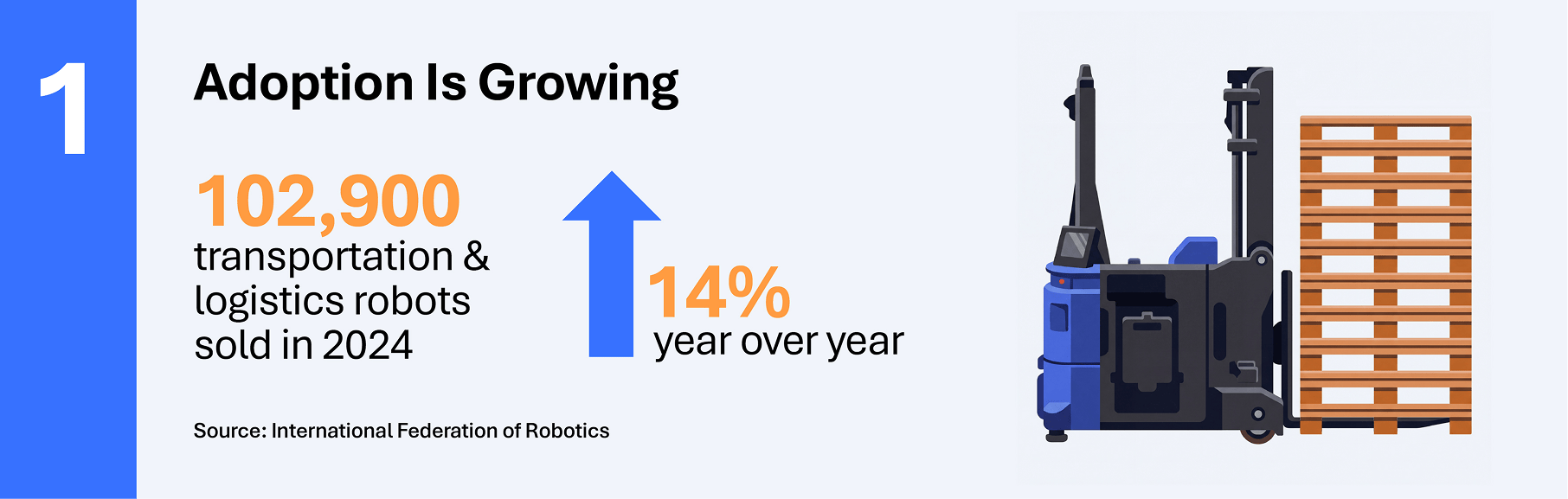
The numbers reinforce that momentum. According to the International Federation of Robotics (IFR), 102,900 professional service robots for transportation and logistics were sold globally in 2024, a 14% increase over the previous year. These systems—primarily mobile robots for transporting and handling goods—accounted for more than half of all professional service robots sold.
So, where is mobile automation headed next?
Here are four trends shaping the market—and what they could mean for operations considering their next move.
1. Adoption Is Growing
Mobile robots have moved well beyond emerging technology.
The IFR’s World Robotics 2025 Service Robots report found that transportation and logistics was the largest application category for professional service robots in 2024, with 102,900 units sold. Indoor transportation, including the movement and handling of goods, was the most important application within the category.
That growth reflects a broader shift in how companies think about material movement. Repetitive transportation that once depended almost entirely on forklifts or other manually operated equipment can increasingly be handled through mobile automation.
For manufacturers and warehouses, that opens the door to evaluating material movement across more of the operation—not simply isolated applications.
2. Workforce Pressures Are Driving Investment
The need to automate is also being shaped by a persistent challenge: finding and deploying people where they can provide the most value.
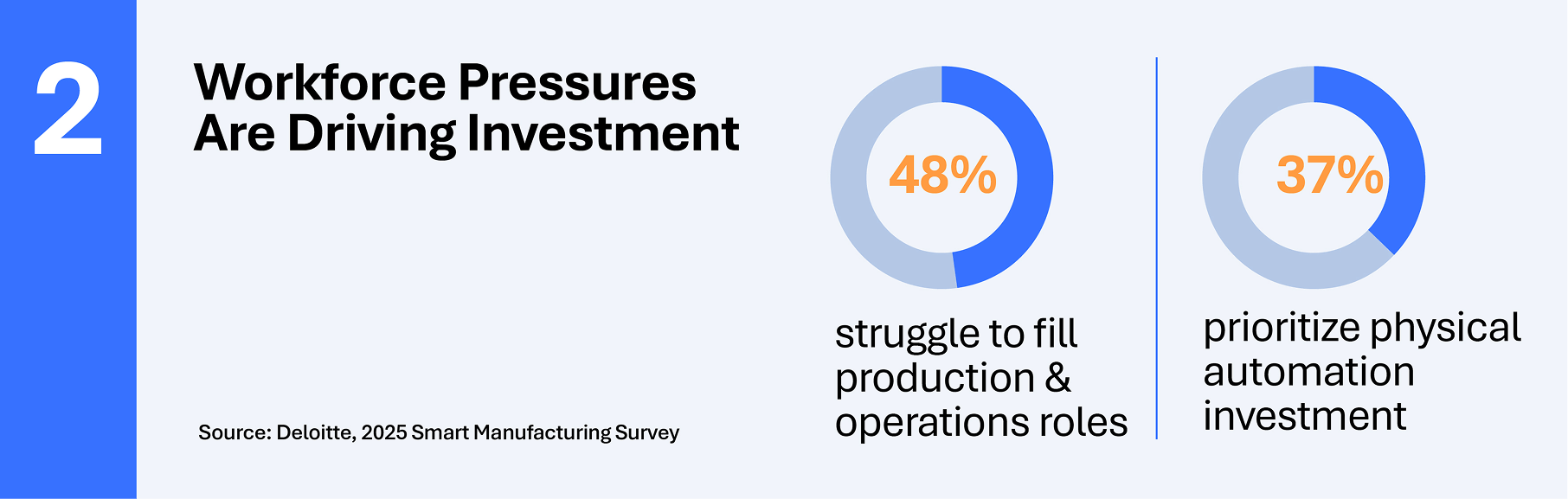
Deloitte’s 2025 Smart Manufacturing Survey found that 48% of manufacturers reported moderate to significant challenges filling production and operations management roles. Looking ahead two years, 37% ranked physical automation as their first- or second-highest investment priority.
For mobile automation, the opportunity isn’t simply replacing labor. It’s rethinking where people are needed most.
When AGVs and AMRs take on repetitive transportation tasks, employees can spend more time on production, quality, maintenance, problem-solving and other responsibilities that benefit from human expertise.
As workforce pressures continue, that ability to make better use of available talent is becoming an increasingly important part of the automation conversation.
3. Multi-Robot Environments Are Expanding
As mobile automation expands, operations are increasingly having to think beyond a single robot or application.
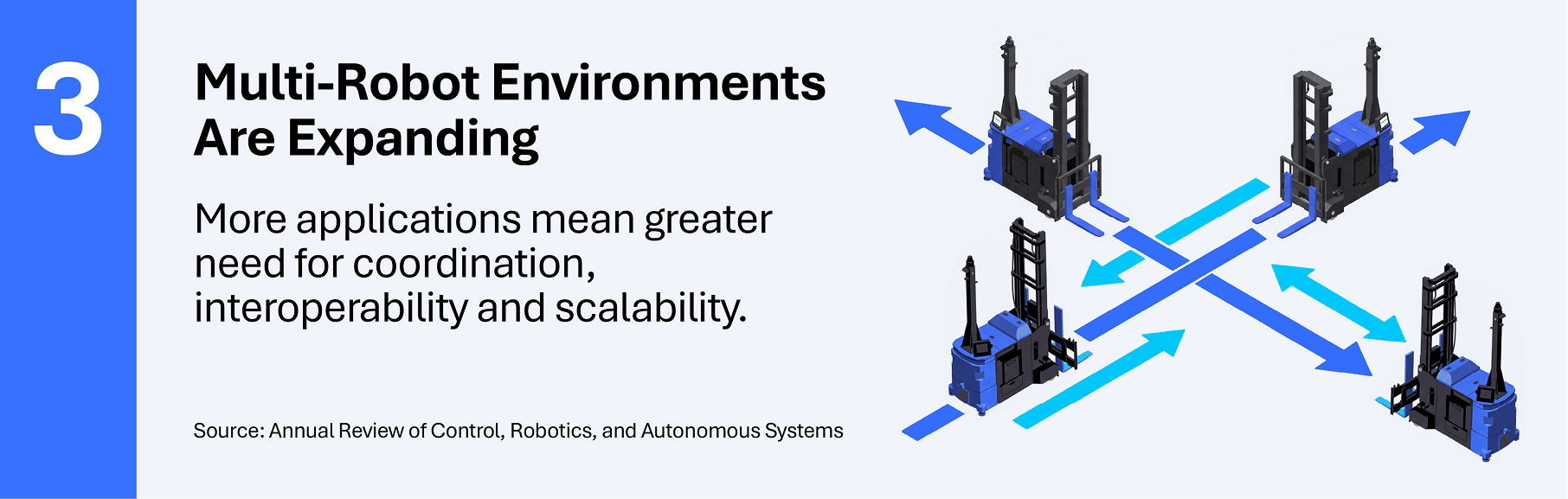
A 2026 review published in the Annual Review of Control, Robotics, and Autonomous Systems highlights multirobot coordination, task allocation and fleet management as important areas in warehouse and logistics robotics. It also identifies interoperability and scalability among the key challenges shaping the technology’s continued development.
That makes sense as automation grows. One application may call for an AGV moving pallets along a predictable route. Another may benefit from a more dynamically navigating AMR. Different payloads, workflows and operating environments can require different technologies.
The challenge is making those individual automation decisions work as part of a larger strategy.
For companies, that means thinking not only about which vehicle best fits the application in front of them, but how easily their automation environment can accommodate different vehicles, applications and technologies as new needs emerge.
That’s an important part of FORMOVA’s Total Automation Intelligence approach: giving companies greater flexibility to choose the right mobile automation technology for each application while creating a more connected approach to managing material movement across the operation.
4. Operations Are Becoming More Connected
Mobile robots don’t work in isolation—and neither does the rest of the facility.
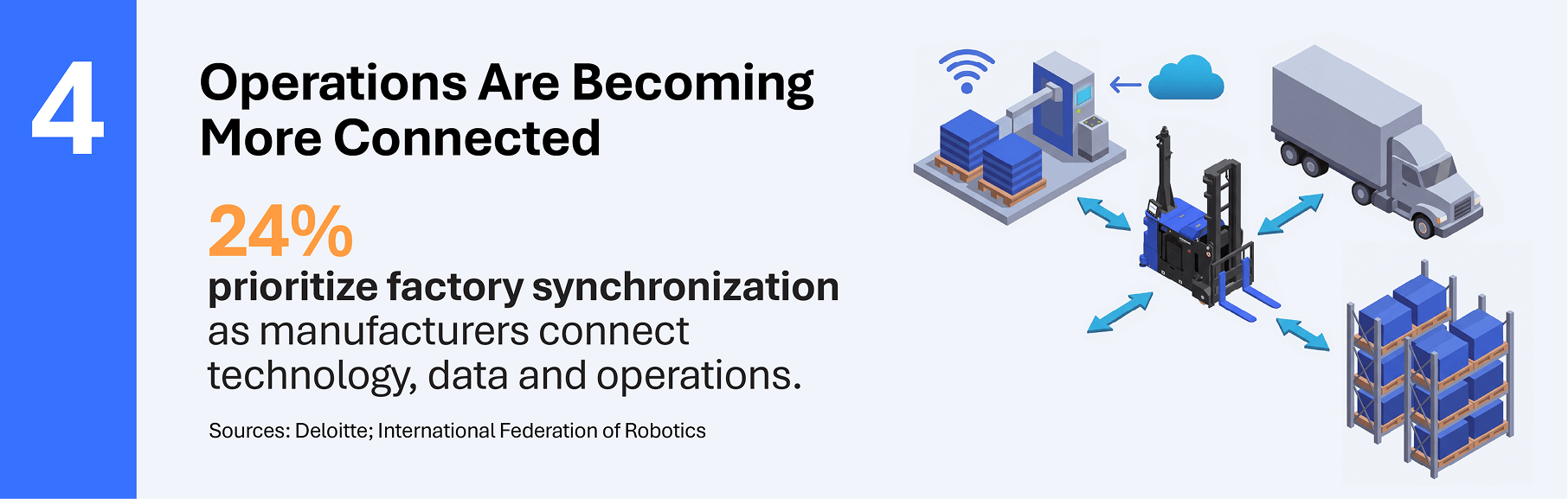
Deloitte found that manufacturers are increasingly investing in the technology and data foundations needed to connect and optimize their operations. In its 2025 survey, 24% of respondents ranked factory synchronization among their top two investment priorities for the next two years.
The IFR similarly identifies the convergence of information technology (IT) and operational technology (OT) as a major robotics trend for 2026, pointing to the value of real-time data exchange between digital systems and physical operations.
For mobile automation, that broader connectivity matters.
An AGV or AMR may need to coordinate with production equipment, conveyors, automatic doors, charging infrastructure and other facility systems. Software also needs to make decisions about routing, task priorities and vehicle activity based on what is happening across the operation.
FORMOVA’s mōt.OS® motion operating system helps provide that system-level view, supporting efficient routing, charging optimization and interactions between mobile automation and the plant environment.
What These Trends Mean for Mobile Automation
Taken together, these trends point toward a mobile automation market that is growing—and becoming more sophisticated.
More companies are adopting mobile robots. Workforce pressures are increasing the need for automation. Interoperability is becoming a bigger consideration. Robotics technology is becoming more autonomous. And automation is increasingly being connected to the systems and infrastructure around it.
For companies evaluating AGVs and AMRs, the opportunity is to think beyond what one vehicle can accomplish.
Consider how mobile automation fits into the operation as a whole. How will it adapt as workflows change? How will it interact with the facility around it? And how easily can the automation environment evolve as new applications and technologies emerge?
FORMOVA’s Total Automation Intelligence approach brings together mobile automation technology, intelligent orchestration, integration expertise and lifecycle support to help companies answer those questions—and build for what comes next.